skip to content link

Heating Installation in Phoenix, AZ

Planning a heating installation in Phoenix while the rules on new equipment are still moving? The heating season here is short, which changes what makes sense to put in and what it is worth paying for. Adams sizes gas furnaces, heat pumps, and packaged rooftop units for the load your house actually has, and pulls the city permit when the job needs one.

Type, size, and whether the house can carry it

Three Choices You Make Before the Equipment Arrives

Three decisions get made before any equipment is ordered, and the order matters. First, what type of system the house should have. Second, how big it needs to be. Third, whether the ducts and the venting can carry what you are buying.

Type comes first because Phoenix has a genuine choice here that colder markets do not. A heat pump covers heating and cooling on one machine and suits a mild heating load well. A gas furnace paired with an air conditioner separates the two jobs and is often the answer where gas service is already in place and the ductwork is built around it. Neither is automatically right, and anyone who tells you otherwise before seeing the house is selling rather than sizing.

Size comes from a load calculation. Heating loads in Phoenix are small compared with most of the country, and the common mistake is carrying over whatever tonnage or BTU rating was there before. An oversized heater short cycles, heats unevenly, and wears out its ignition components early, the same way an oversized air conditioner does in July.

Then the practical constraints. A condensing furnace produces liquid condensate and cooler exhaust, so it needs drainage and a venting arrangement that an older atmospheric chimney will not provide. On a rooftop package unit that is a real piece of work, not a footnote. We look at all of it before quoting, and we tell you what the ducts need rather than discovering it on install day.

Five Ways Phoenix Changes a Heating Install

A heating system here is not a smaller version of a Midwest one. It is a different problem, because the equipment spends most of the year doing something else entirely or sitting still.

  • Short season: the heating load here is small, so paying for capacity you will use a few weeks a year rarely returns the money.
  • Mixed housing: the central grid neighborhoods, the postwar ranch belt, and new builds each want a different answer on type.
  • Rooftop equipment: a lot of Phoenix housing carries a packaged unit on a flat roof, which changes venting, drainage, and access.
  • Shared ductwork: whatever heats the house in January is usually cooling it in July through the same ducts, so duct work is one decision.
  • Permit line: adding or relocating a furnace requires a City of Phoenix permit, and we pull it rather than leaving it to you.
Worth knowing
The Ducts Are Half the Job

New equipment on tired ductwork underperforms in both seasons. We tell you what the ducts need before you buy, and we tell you when they are fine.

Call (602) 269-6447

Four Rules That Govern New Heating Equipment

The 80 Percent Floor Today

Non-weatherized gas furnaces currently have to meet a minimum of 80 percent AFUE, a Department of Energy standard that has been in place since 2015. Anything you buy and install now sits at or above that line, and most equipment on the market clears it comfortably.

The 95 Percent Rule Coming in 2028

DOE finalized a rule in 2023 raising that minimum to 95 percent AFUE for furnaces manufactured on or after December 18, 2028, which effectively means condensing equipment. As of August 2026 the rule stands, but it is unsettled. The D.C. Circuit upheld it in November 2025, the Supreme Court vacated that ruling in June 2026 and sent it back, and DOE has sought comment on delaying compliance to at least January 2030.

Heat Pumps Answer to a Different Number

Split system heat pumps carry a national minimum of 14.3 SEER2 and 7.5 HSPF2, identical in every region and enforced by date of manufacture. Packaged heat pumps sit at 13.4 SEER2 and 6.7 HSPF2. If you go the heat pump route, this is the floor rather than the furnace rule.

The City Wants a Permit

City of Phoenix guidance requires a permit to add or relocate a furnace, air conditioner, or evaporative cooler, or to change unit size, capacity, or location. A new heating installation almost always lands inside that. We handle the permit as part of the job.

Heat Pump or Gas Furnace, Side by Side

Both are correct answers in this city. Which one is correct for your house depends on the ducts, the gas service, and what you already own.

Heat Pump

One machine, both seasons
  • One machine covers heating and cooling, so there is one system to maintain instead of two.
  • Suits a mild heating load, which is what Phoenix actually has.
  • No gas line, no combustion, no flue, and no condensate venting question.
  • The floor is 14.3 SEER2 and 7.5 HSPF2 on a split system, set nationally.
  • One failure affects both seasons, because both seasons run through the same equipment.

Gas Furnace

Two machines, two jobs
  • Separates the jobs, so a heating failure does not take your cooling with it.
  • Often the simpler answer where gas service and the venting already exist.
  • Minimum today is 80 percent AFUE, with the 95 percent rule scheduled for December 2028.
  • Condensing equipment needs drainage and venting an old chimney will not provide.
  • Pairs with a separate air conditioner, which is a second system to buy and maintain.

Adams installs and services both, so there is no house answer we are steering you toward. We are the HVAC contractors in Phoenix who will still be servicing whichever one you choose in ten years.

Six Things You Can Check on Us

Verifiable rather than claimed.

Since 1947

Adams has installed heating equipment in Phoenix for more than seventy five years, across every era of local housing stock and every rule change along the way.

4.6 Star Rated

The Google rating and review count come straight from the listing rather than being typed into the page, so it moves when customers move it.

Locally Owned

One shop on North 35th Avenue, locally owned and operated, with the parts counter in the same building as the trucks.

Available 24 Hours

An install is scheduled work, but the line is open every hour afterwards, which is the part that matters once the equipment is yours.

Carrier Factory Authorized

Factory training and a direct parts channel on Carrier equipment, with installation and service on every other major brand in the Valley.

Free 3-Year Maintenance

Every new unit purchased from Adams includes three years of maintenance in the price of the system, not sold as an add on afterwards.

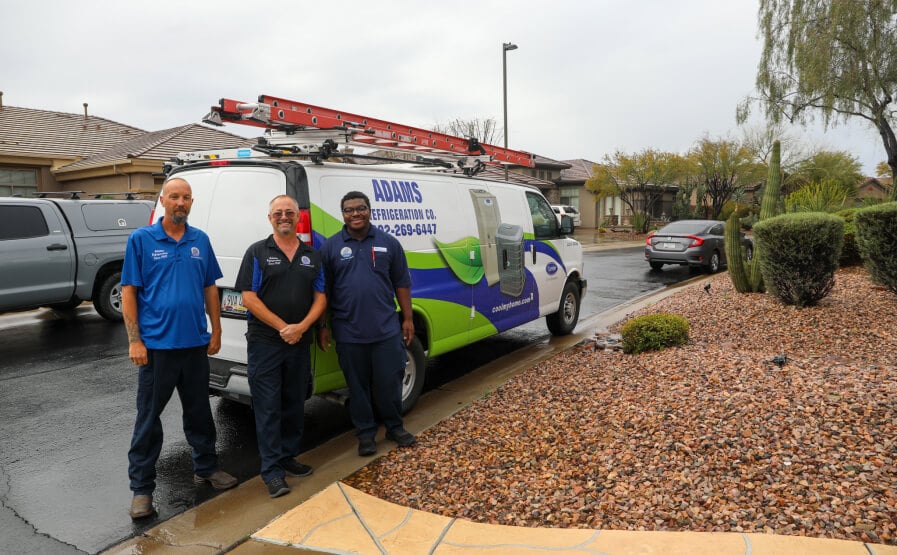
Adams Refrigeration Team

Heating Installation in Phoenix
Five Questions Before You Buy

Should I put in a heat pump or a gas furnace in Phoenix?

Arrow Down

It depends on what the house already has. Where gas service and suitable venting exist and the ductwork is built around a furnace, a furnace is often the simpler answer. Where neither is in place, a heat pump covers both seasons on one machine and suits a mild heating load. We size the house first and then talk about type.

Do I need a permit for a heating installation in Phoenix?

Arrow Down

Usually yes. City of Phoenix guidance requires a permit to add or relocate a furnace, air conditioner, or evaporative cooler, or to change unit size, capacity, or location. A new install generally falls inside that. We handle the permit rather than leaving it with you.

What is the 2028 furnace rule, and does it affect me now?

Arrow Down

DOE finalized a standard in 2023 requiring non-weatherized gas furnaces manufactured on or after December 18, 2028 to meet 95 percent AFUE. It does not force anyone to replace a working furnace. Its status is genuinely unsettled: the D.C. Circuit upheld it in November 2025, the Supreme Court vacated that ruling in June 2026, and DOE has sought comment on delaying compliance. We will tell you where it stands when you buy.

How do you decide what size heater my house needs?

Arrow Down

A load calculation, not the rating of the old unit. Square footage, ceiling height, window area and exposure, insulation, and duct condition all feed it. Heating loads here are small, and carrying over the previous size usually means carrying over a mistake.

Can you install heating on a rooftop package unit?

Arrow Down

Yes, and it is common on flat roof homes and small commercial buildings across Phoenix. It changes the job rather than the equipment: roof access, curb work, condensate drainage, and venting all have to be planned rather than improvised on the day.

Still have a question?

If you don't find your question addressed above, feel free to contact us.

Contact Us

Planning the Install Before Winter?

Start with a load calculation and a written quote. Arizona ROC 245268.

One Visit to Size It Right

Adams Refrigeration has installed heating equipment in Phoenix since 1947. Book a time or call the line below, and we start with the load calculation rather than a catalogue.